

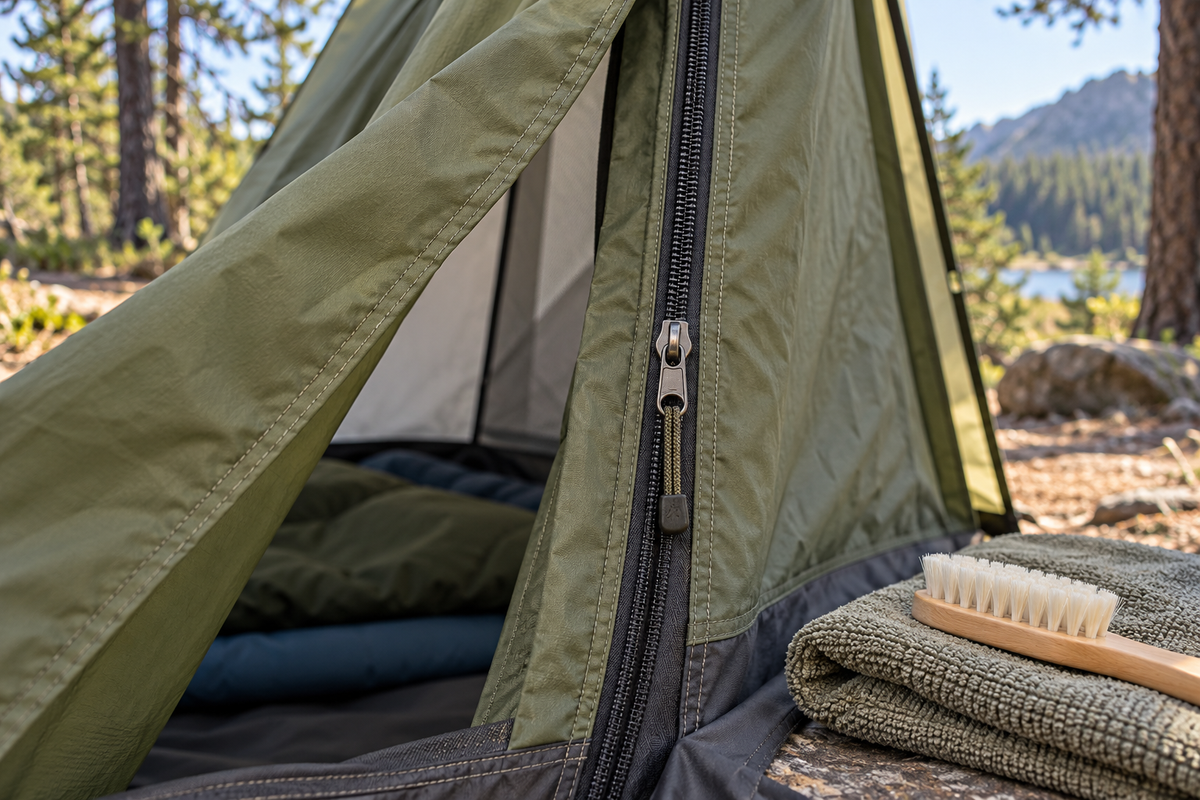
A tent zipper stops halfway around the door. Pulling harder is tempting, especially when you are tired, but the resistance is information. Fabric may be caught, grit may be in the zipper, or the closure may need repair. Those problems do not all have the same solution.
Start with the tent manufacturer's care instructions. The approach below helps you describe the problem and recognize the boundary between gentle care and a repair that needs model-specific guidance. It is not a universal zipper-replacement procedure.
First describe what the zipper is doing
Look at the slider, the adjoining fabric and the line of zipper elements. Is the slider unable to move? Does it travel roughly along several inches? Or does it move while the two sides separate behind it?
Those descriptions are more useful than “the zip is broken.” Also note whether the problem occurs on the mesh inner door, the fabric inner door or the rainfly. A tent can have several closures with different parts and loading conditions.
Do not keep making full-speed passes to see whether the problem disappears. Stop at resistance, provide enough light to see the area, and avoid pulling the doorway sideways while inspecting it. If the material is already torn or the zipper visibly damaged, move directly to manufacturer support.
For a simple snag, go gently backward
NEMO's ultralight-gear care guidance says to stop when a zipper sticks, move the slider back slightly and look for fabric or debris. It advises gently freeing the obstruction and continuing slowly, with the fabric supported rather than pulling at an angle.
This is a small, careful movement, not permission to tug until something gives. If the slider will not move gently or the caught fabric will not release, stop. Cutting the fabric or crushing the slider with a tool turns a care question into a different repair.
Once a simple snag is released, keep the loose flap away from the moving slider. If the same spot catches again, note that location rather than repeatedly forcing your way past it.
Grit calls for cleaning guidance, not an improvised lubricant
Sand and dirt deserve attention before more operation. The Hotcore tent owner's manual, for example, advises removing dirt or sand with a small brush or water and specifically warns against forcing a reluctant zipper. Use the cleaning method approved for your own shelter.
Do not assume that an oil, wax, household cleaner or spray suitable for another zipper is suitable for the tent's fabric and coatings. If the care instructions do not identify an appropriate product, ask the maker before applying one.
Keep the cleaning task modest. You are removing accessible contamination, not trying to grind a rough section smooth. After any approved wet cleaning, follow the tent's drying instructions before storage.
Look at the pitch before blaming the hardware
If the door becomes difficult only when the tent is pitched, compare the setup with the exact pitching instructions. Check that the intended poles, clips and attachment points are being used correctly. Do not use the zipper to pull a distorted doorway into position.
NEMO emphasizes even structural tension and pausing when something feels wrong. That does not create a universal instruction to loosen every guyline. Correct tension depends on the tent, and required anchoring still matters. Review the setup in calm conditions or ask the maker for help with photographs of the pitched shelter.
A zipper that separates may need a matched repair
When the slider moves but the closure opens behind it, cleaning alone may not resolve the problem. Big Agnes's slider-repair guidance describes replacement options for specified YKK #3 tent zippers and asks customers to provide their tent model. It also distinguishes slider work from damage to the zipper teeth.
The important lesson is compatibility. A slider that looks similar is not automatically the right part. The manufacturer needs to identify the closure and assess whether its elements, fabric and stitching are still suitable for the proposed repair.
Do not copy a cutting or replacement sequence from a different tent. Request the procedure and parts for your exact shelter, or use the manufacturer's repair service when available.
Make the support request easy to answer
Provide the model, which door is affected, a clear close-up and a wider photograph showing the surrounding fabric. Describe whether it sticks, feels gritty or separates, and what gentle care you have already tried. Keep the original parts in place unless instructed otherwise.
Before relying on the shelter for another trip, confirm that the affected door works properly through its intended travel. A zipper that closes once but immediately separates again is still an unresolved problem. Addressing it at home gives you more options than discovering it after dark at camp.
Cover: an original illustration of intact tent equipment, not a repair demonstration.


 Tents & Shelter
 Sleep Systems
 Packs & Hiking
 Camp Kitchen
 Light & Power
 Survival & Skills
 Camping 101
 Fishing