

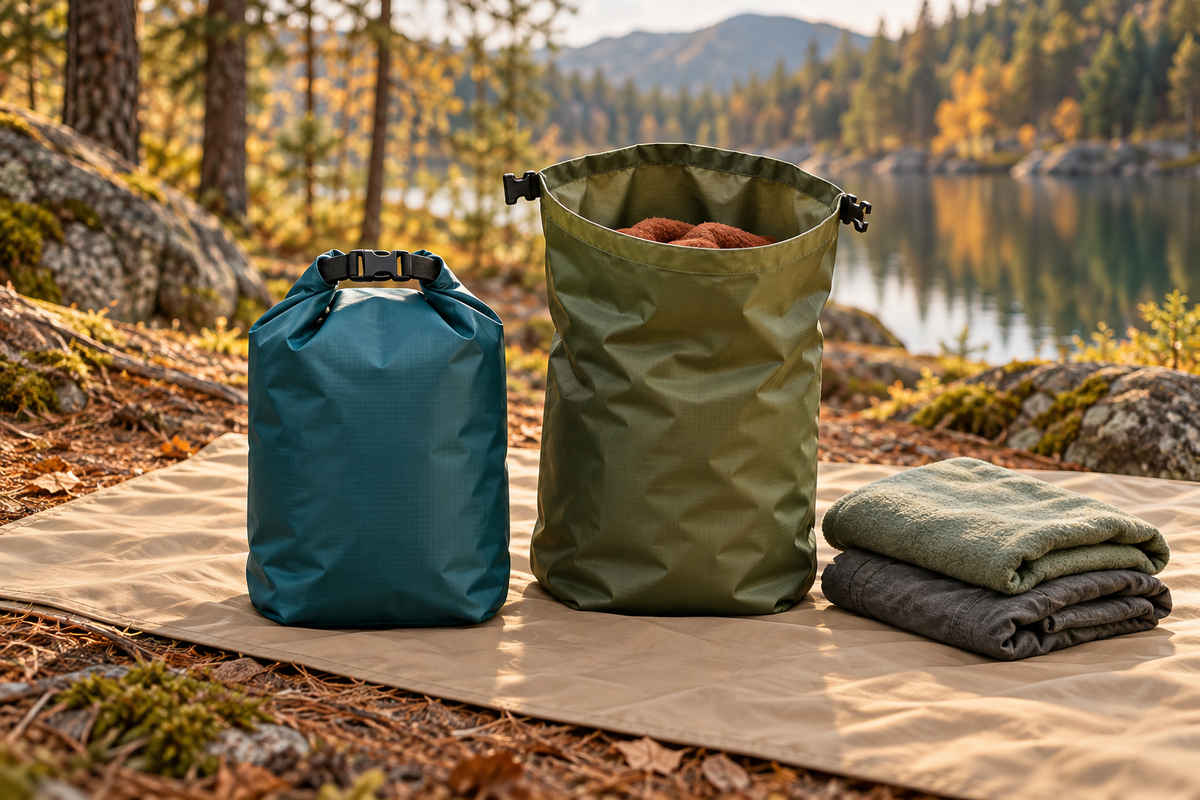
A dry bag can swallow your spare clothes and still be too full to close as its manufacturer requires. When choosing one, leave room for the closure and rehearse the way you will open, repack and carry it. The advertised capacity is only the beginning of that decision.
This guide focuses on packing ordinary camping gear. It does not certify a bag for immersion, water sports or protecting electronics. Use the intended-use limits and closure instructions for the exact product you own.
Give the bag one clear job
Start with a group of items rather than a liter number. You might want one bag for dry sleep clothing, one for a spare layer or one larger bag to organize gear inside a backpack. Lay out those items before deciding on a size.
Keep items you will need repeatedly separate from items that can stay packed until camp. If a small personal item is buried beneath all your sleep clothing, every stop becomes a complete unpacking exercise. A simpler arrangement may use fewer pieces of gear than a collection of bags bought without a plan.
Also decide whether the bag will travel inside another pack or be carried on its own. Shoulder straps, attachment points and an appealing fabric description do not establish suitability for every environment. Check the manufacturer's intended use before treating one design as an all-purpose outdoor bag.
Reserve the space needed to close it
For a roll-top design, the neck is part of the closure. Pack the intended contents and leave enough free material to make every fold or roll required by the instructions. Do not count a buckle that can just be stretched together as proof of a correct closure.
As a manufacturer-specific example, Sea to Summit's roll-top guidance describes removing excess air, making the initial fold over its seal strip, rolling at least twice more and securing the buckle. That sequence belongs to the products covered by that guidance; use the directions supplied for your own bag.
If the load prevents the prescribed closure, remove items or choose a different size. Do not compensate by reducing the required rolls, forcing the buckle or assuming an extra strap creates an equivalent seal.
Try the packed shape inside your actual backpack
A filled bag's shape matters as much as its nominal volume. Place the properly closed bag where it will travel and pack the rest of your usual equipment around it. Check that it goes in and comes out without catching or needing to be forced.
Try the arrangement with the items you will actually bring, not just a soft substitute that compresses more easily. A long narrow bundle and a short wide bundle can occupy space differently even when their advertised capacities sound similar.
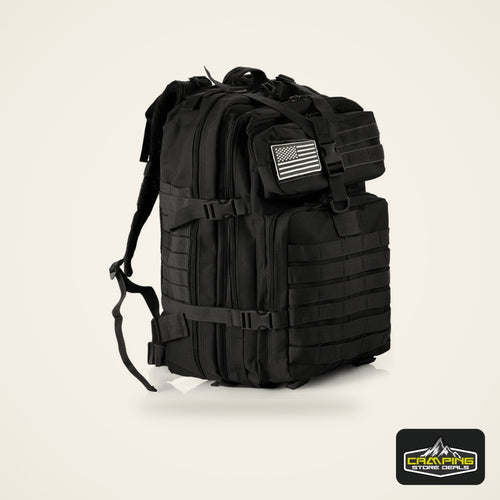
The IDRYBAG dry-sack-style backpack listing, for example, is a starting point for questions about its selected size, closure and intended use. Ask for the model-specific directions and closed, usable dimensions where needed. The listing's waterproof wording does not establish a submersion rating in this guide.
Rehearse one ordinary retrieval
Choose an item you expect to need during the day. At home, remove the packed bag, open it normally, retrieve that item and repack everything. Notice what has to be put down and whether the bag still closes correctly after a less-than-perfect refold.
If the routine is awkward on a clean floor, revise the packing order before relying on it at camp. Put frequently used items in an appropriate accessible location rather than repeatedly opening the group of gear you want to leave undisturbed.
Keep a simple note of what goes in each bag. Color can help, but a packing list is clearer when several bags look alike. Use your backpack pocket map to show where each closed bag belongs.
Keep wet contents separate from dry contents
Decide in advance where a damp towel or used rain layer will go. Do not return it to the same group of dry clothes merely because there is spare space. The packing plan should account for the trip home as well as the departure.
Separate containment is temporary organization, not a drying method. Follow each item's care instructions and open, clean and dry the relevant gear when you can do so properly. Add the bags themselves to that routine rather than leaving them packed between trips.
Before reuse, inspect the bag and closure as the manufacturer directs. Sea to Summit's guidance calls for checking fabric and coating condition and not using a damaged bag. Ask the manufacturer about the appropriate repair or replacement route for your particular item rather than improvising a seal.
Treat electronics as a separate protection decision
A dry-bag purchase should not quietly become a promise that a phone or camera can survive immersion. Sea to Summit's electronics-packing guidance warns that water can eventually enter a submerged roll-top closure and that condensation is also possible inside an enclosure.
Choose protection for the device and exposure involved using the relevant manufacturers' documented limits. Do not test a new bag by immersing valuable electronics. A clothing-packing rehearsal answers questions about organization and closure space, not water-protection performance.
Before buying, finish with four answers: what goes inside, how the bag must close, where the closed package fits and what its documented use limits are. If any answer is missing, resolve it before the next trip.
Cover: original conceptual packing illustration, not a product-specific closure demonstration or waterproofness test.


 Tents & Shelter
 Sleep Systems
 Packs & Hiking
 Camp Kitchen
 Light & Power
 Survival & Skills
 Camping 101
 Fishing