

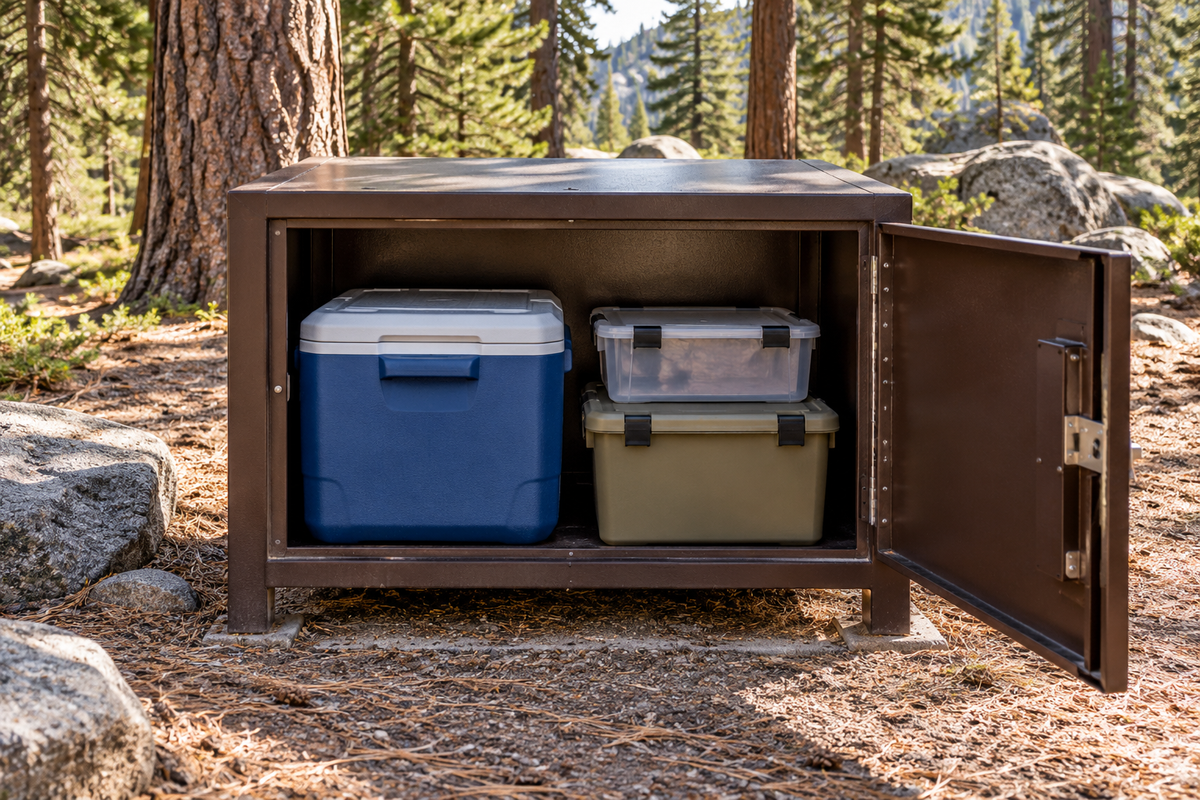
Your cooler may fit in the car and still be awkward to store at camp. Where a campground requires a food locker, the useful packing question is whether the cooler, dry food and other required items can all fit inside with the door properly closed.
Plan that space before loading the trunk. A short measurement and packing check at home is easier than sorting several bulky bins beside a campsite after dark.
Start with the campground's current instructions
Read the land manager's food-storage guidance for your exact destination and type of stay. Developed campgrounds, trailhead parking and backcountry trips can have different requirements. Check the reservation information for locker availability and any published dimensions, then look for current alerts.
The National Park Service's food-storage guidance advises checking park-specific rules before a visit. A bear-resistant label on a product is not a substitute for that destination's accepted storage methods. If the instructions are unclear, ask the campground or land manager before choosing containers.
Save the relevant page with your trip details. Note which campground it covers and when you checked it, especially if your itinerary includes more than one park.
Measure the outside of the cooler
Cooler capacity describes storage inside the cooler. Locker fit depends on its outside dimensions. Measure the complete item, including protruding handles, hinges, wheels and latches, in the position you plan to store it.
Check three separate questions:
- Can the cooler pass through the locker opening?
- Can it sit inside without blocking the door or latch?
- Is there usable room left for the rest of the items that must be secured?
Published internal dimensions are a starting point, not a promise about every opening or obstruction. Avoid planning a millimeter-perfect fit. If your equipment is close to the stated limit and the opening size is not published, request clarification or choose a smaller arrangement.
Yosemite's food-locker page lists different dimensions for different campgrounds and lodging areas. That is a useful reminder to match the measurement to your actual destination rather than copying a number from another traveler's campsite.
Make a complete storage pile
Put all the items covered by the campground's rules together before deciding how many bins to bring. Food is only the beginning. The required list may also cover toiletries, trash, drinks, cooking equipment and other attractants.
For example, Yosemite's bear and food-storage guidance includes scented items, unwashed eating or cooking items and ice chests, even when empty. It also tells campground visitors to keep lockers closed and latched and to put away food that is not in use.
Use the actual packed containers for this check. An empty cooler beside a flat shopping bag gives a misleading picture of the space your full camp kitchen will need. Include the toiletries bag and the container intended for waste while it awaits proper disposal.
Rehearse a workable packing arrangement
Mark the published locker footprint on a clear floor with removable tape. Arrange your containers inside that outline, then check their heights and any planned stacking. This is a packing rehearsal, not proof that the real locker opening will accept the arrangement.
Start with the least flexible object, often the cooler. Fit smaller containers around it, keeping the frequently used items reachable. If reaching one snack requires unloading everything, simplify the arrangement. A setup that is easy to use makes it easier to put items away promptly.
Avoid adding several rigid bins just to make the car look organized. Each lid and handle consumes space. Smaller containers can offer flexibility, but they still need to be suitable for their contents. Ordinary organizers do not become bear-resistant storage by being placed near a locker.
Plan for the rest of the group
If you are sharing a campsite, agree on the food-storage plan before everyone packs independently. Count the group's coolers, pantry bins and toiletries together. Confirm whether the location provides one locker per site or shared storage, and do not assume that an unoccupied locker belongs to your party.
Assign one person to collect the dimensions and make a simple packing sketch. Each household can then see how much room is available. If the plan does not fit, reduce unnecessary packaging or change container sizes before departure. Do not solve an overcrowded locker by planning to leave required items outside.
Check the real locker when you arrive
Inspect the space and closure before unloading the whole vehicle. If the locker is damaged, will not latch or differs materially from the information you used, contact campground staff for an approved solution. Do not improvise repairs to park equipment.
Follow the destination's rules whenever items are not in immediate use. Do not assume that a locked car is an acceptable overnight fallback: Yosemite, for example, directs visitors not to store food in cars or trucks after dark and provides separate guidance for hard-sided RVs.
Before bed or leaving camp, check the picnic table, bags and pockets for forgotten items, then confirm that the locker is properly closed. Good planning leaves enough room for the whole storage requirement and a simple routine that every camper can follow.


 Tents & Shelter
 Sleep Systems
 Packs & Hiking
 Camp Kitchen
 Light & Power
 Survival & Skills
 Camping 101
 Fishing