

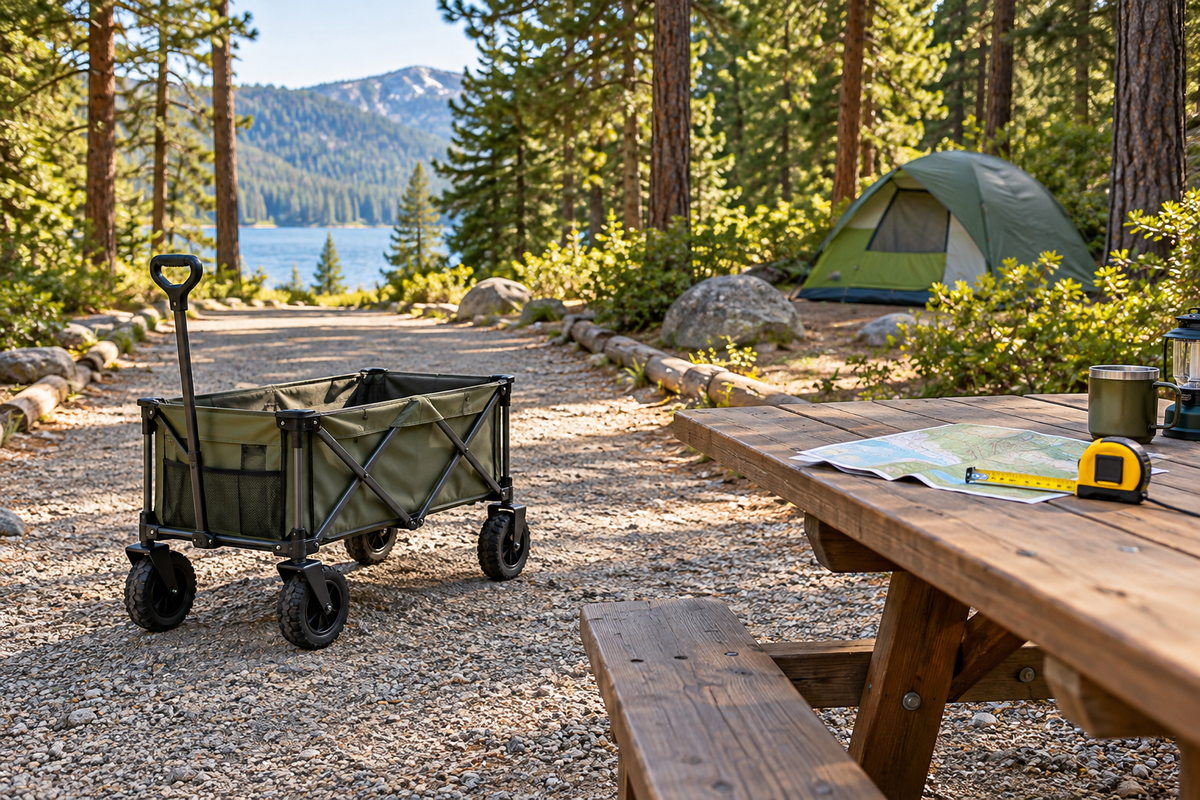
A folding wagon can change how you move camping gear, but it only helps when the route and campground rules suit it. A short walk may include steps, a narrow gate or soft ground. A campsite described as “walk-in” may not permit a wheeled cart at all.
Before building a load around your wagon, check the journey from the actual parking space to the actual site. This guide is for manually pulled gear wagons. Motorized carts and mobility devices have separate rules and needs.
Confirm permission for the complete route
Read the campground's official information, reservation notes and current restrictions. Look for references to wagons, wheeled coolers, carts and non-motorized wheeled equipment. If the wording is unclear, ask about your exact campsite and the path you would use to reach it.
Rules can differ within one park. Congaree National Park's current compendium allows wheeled non-motorized carts in Longleaf Campground but prohibits them in Bluff Campground, on hiking trails and in wilderness. That is a useful reminder to check the named campground rather than assuming a park-wide answer.
Write down the answer with your reservation. A photo of someone using a wagon, an old review or a product labeled “all terrain” cannot establish permission. Stay on the permitted route even when a shortcut looks easier.
Ask whether a cart is already provided
You may not need to bring your own. Wisconsin DNR's Wildcat Mountain camping information, for example, says carts are supplied for its cart-in sites and describes travel on foot of no more than 400 feet from the parking lot.
Treat that as a destination-specific example. For your booking, confirm where a shared cart is collected, whether it must be returned promptly and whether there are any availability arrangements. A provided cart can save trunk space, but you still need bags you can handle if it is temporarily in use.
Build a route note with six details
- The assigned parking location and the one-way distance to the site.
- The surface: pavement, firm gravel, loose sand, roots or another material.
- Steps, steep sections and changes in level.
- Narrow gates, posts, bridges or sharp turns.
- Any seasonal closures or recent access changes.
- Where you can unload without blocking other campers.
A map is useful for distance, while recent official photographs may reveal obstacles. Neither guarantees current ground conditions. Ask the campground about details the listing does not show, especially if your plan depends on avoiding steps.
Do not assume an accessibility label is a wagon specification. It does not tell you your cart's width, loaded handling or suitability for the surface. Compare the route information with the actual equipment you intend to bring.
Compare three different sets of dimensions
First, check the usable cargo space. Measure your cooler, tent bag and storage bins rather than relying on their nominal capacities. A cooler's handles and lid shape may matter as much as its main body.
Second, check the wagon's complete outside dimensions when open, including wheels and protruding hardware. Cargo-bed width alone will not answer whether it passes through a gate. Leave practical room to steer and walk beside it where necessary.
Third, check the folded dimensions and empty weight. Try the folded wagon in the vehicle with the rest of your gear. Include the effort of lifting it in and out; solving the campsite walk should not create a packing problem at the car.
Read the load limit in context
Use the manufacturer's instructions for the exact model and configuration. If a wagon converts into another item, check the limits and setup instructions for each mode separately. Ask the seller to clarify any missing units or unclear measurements before purchasing.
For example, when reviewing our collapsible folding wagon cart, confirm the cart-mode dimensions, folded size and operating instructions for the selected version. A stated maximum load does not promise easy pulling on your campsite's surface.
Keep every load within the documented limits and arrange it as instructed. Do not use a gear wagon to transport people unless its manufacturer explicitly designed and approved it for that purpose. A seat-like shape or convertible feature alone is not permission to ride in cart mode.
Rehearse a manageable packing plan
Before departure, unfold and secure the wagon according to its instructions. Try a modest load on an appropriate level surface. Check whether bags remain contained, the handle is comfortable and you can turn and stop it under control. Reduce the load if it is awkward.
Pack in separate manageable bags so you can change plans. Keep arrival essentials easy to reach instead of burying them under the cooler. If steps or unsuitable ground make the wagon impractical, choose a different permitted transport plan before committing to a heavy load.
The best result is a gear-moving plan that works both ways, including the trip back to the car. Confirm the route, verify the wagon's limits and leave yourself a practical alternative.
Cover: original conceptual illustration, not a photograph of a named campground or an exact product model. Destination information checked October 14, 2026; confirm current rules before travel.


 Tents & Shelter
 Sleep Systems
 Packs & Hiking
 Camp Kitchen
 Light & Power
 Survival & Skills
 Camping 101
 Fishing