

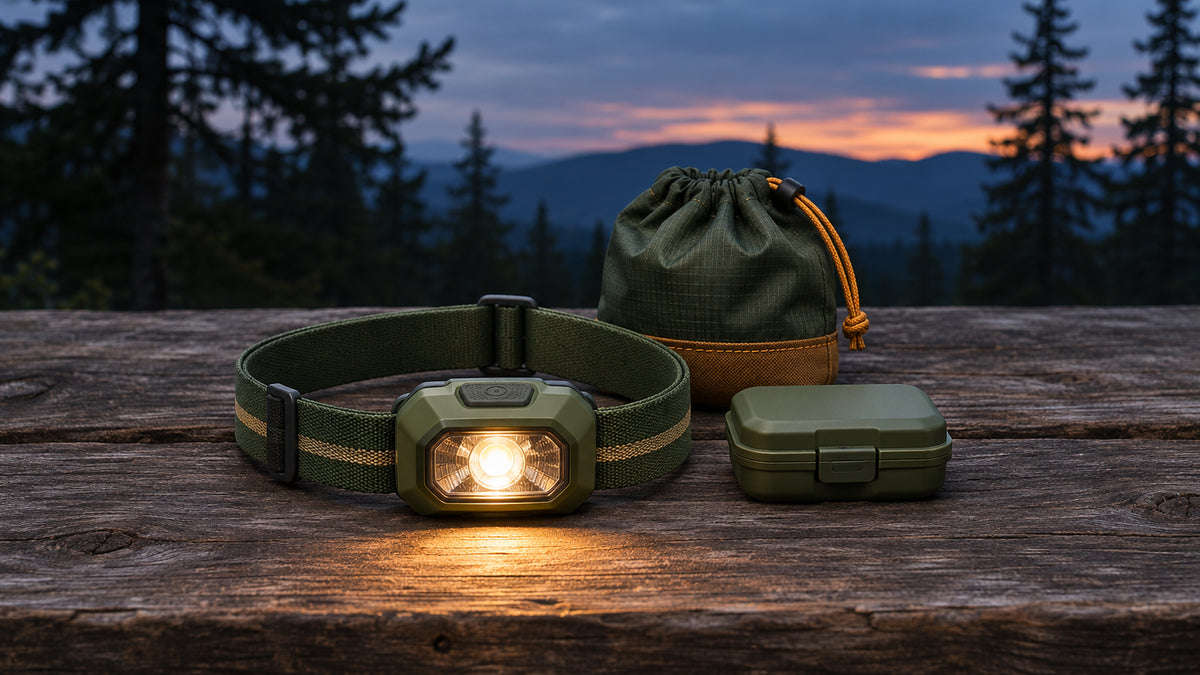
A headlamp that lights up for a second in the kitchen isn’t necessarily ready for camp. Can you turn it on without hunting for the switch? Is the charging cable actually the right one? If the lamp runs out, can you find the spare power without the lamp itself? A short rehearsal at home answers those questions before the tent goes up.
Start with the power source you’ll actually pack
Set out the headlamp, its backup and the cable or spare batteries you intend to take. Identify the exact model on the lamp or in its manual, especially if several lamps in the house look alike. Some designs accept a removable battery pack or compatible AAA cells, while others use an integrated battery. For example, Petzl’s CORE compatibility guide explains which lamps accept its pack; don’t assume it works in every Petzl lamp, let alone another brand.
For a rechargeable lamp, connect the exact cable and power source you’ll carry and confirm that the lamp indicates charging as described in its manual. For a replaceable-battery lamp, check the manual for the supported cell type and keep any spare set protected in a dedicated case. Make sure the pack contains a complete spare set, not a mixture pulled from a junk drawer. If there’s an unexpected change in brightness or the lamp won’t hold a charge, investigate it before the trip rather than counting on it at night.
Try the controls on a real task
Dim the lights at home, point the lamp toward the floor and practice selecting the setting you’d use to look through a bag or work at a picnic table. Next, try the control with the gloves you intend to take. If the model has a transport lock, practice switching it on and off without looking at the instructions. Leave a quick note in the pouch if the button sequence is easy to forget. Finally, adjust the strap with the hat or hood you plan to wear. A lamp that sits well on bare hair can fit differently over a winter hat.
The aim is not to measure runtime or prove that the headlamp will work in every condition. It’s to expose small problems while a room light, outlet and spare gear are still at hand. If you’re choosing a different lamp rather than preparing one you already own, start with the headlamp buying guide for an overview of power types and controls.
Keep a backup you can find without the main light
Choose one consistent outer pocket for a working backup light and tell anyone who might need it where it is. If the headlamp and backup are both rechargeable, check both and consider what happens if you lose or forget the shared charging cable. A second lamp still helps if it’s already charged and accessible. At a family campsite, it can be useful to check everyone’s lamps one at a time instead of dropping them into a single gear tote and sorting them by feel later.
Reset the kit when you get home
Check the lamp and power accessories before storing them, then follow the model’s instructions for drying, charging and extended storage. The instructions can differ by battery and lamp design. For example, this Petzl technical notice calls for removing and periodically charging its rechargeable battery during long storage; that is an example, not a schedule for every lamp.
Pack check: lamp switches on in the mode you use, the actual cable charges it or the right cells are packed, the transport lock works if fitted, and the backup is in an easy-to-find pocket.


 Tents & Shelter
 Sleep Systems
 Packs & Hiking
 Camp Kitchen
 Light & Power
 Survival & Skills
 Camping 101
 Fishing